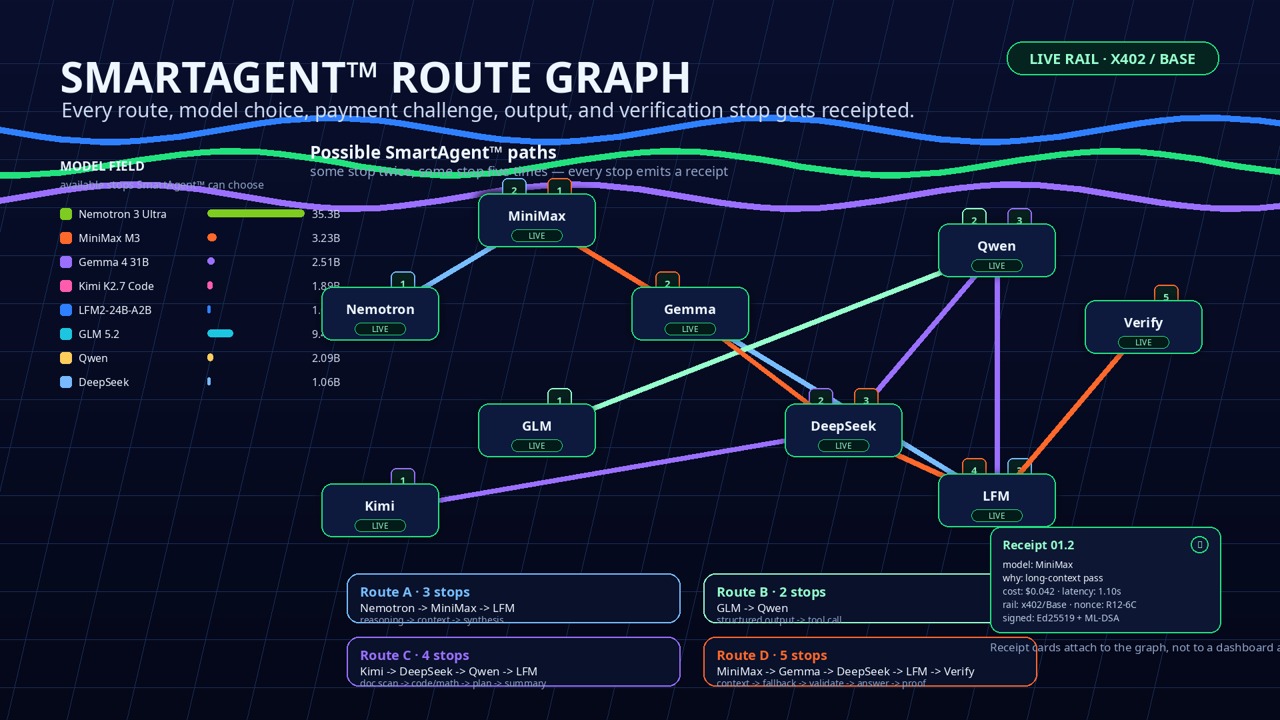
SmartAgent™ Route Graph
This trip is one route. See the whole graph.
Agents route across model stops (2, 3, 4, or 5 hops) and Hive receipts every one. Agents choose routes; Hive proves why →
Every agent run splits into two parts. A decision layer picks the route, the model, the provider, and any reroute. A receipt layer writes down each of those choices as a signed record. Hand over the receipts at the end and you get an audit trail. Stream them while the call runs to an outside dashboard, and someone watching can correct, reroute, or pause the trip while it is still moving. That is how Hive turns agent receipts into verifiable AI agents.
Objective, plan, model, provider, reroute. This is the control layer that sits above inference. When one provider is cheaper, faster, or a better fit for the job, the agent can reroute, the same way a driver switches roads without changing the destination.
Each decision gets a standard format, a hash, and a signature using ML-DSA-65. Receipts link to the one before them, so together they form one record of the whole trip. Stream them live, and someone watching from outside holds the same evidence the agent does, at the same moment.
One button runs a short trip of seven route decisions. Each event streams in, then mints a receipt: a real ML-DSA-65 (NIST FIPS 204) signature over the canonical decision body, chained to the one before it, and verified in your browser against a keypair minted in memory for this run. Nothing is stored. Nothing is sent to a server.
N/AN/AN/ANumbers here are measured in your browser as the demo runs: a run streams seven receipts in about four seconds, and every ML-DSA-65 signature verifies right in your browser in tens of milliseconds. One recent run took under 35 ms across all seven. Provider-token cost is zero because no external inference call executes in this browser demo. The provider cost and latency shown inside the trip are modeled, not measured; the count and verify time above update to the run you just watched.
The control-plane idea is the point: an agent that reroutes inference between providers when one is cheaper, faster, or a better fit, and signs a receipt for the decision, is the control layer sitting above inference. This page renders that route and proves the decisions. It does not claim the underlying provider calls ran here.
The reroute in the trip above is not a jump to the lowest price. Before it commits, the decision layer scores each candidate route across the factors that actually decide whether a task should run there. Cost is one column, not the whole table. A provider that is fractionally cheaper but slower, lower quality, out of policy, or in the wrong jurisdiction loses to the route that clears every factor. This is not a race to the bottom; it is a route chosen on the full picture and receipted so the choice can be checked.
| Factor | What the agent weighs | Why price alone fails |
|---|---|---|
| Speed | Throughput and time-to-first-token for the task class. | A cheaper route that misses the latency ceiling fails the task, not just the budget. |
| Latency | Observed p50 and tail latency under real load, not a headline number. | Tail latency is where a cheap route quietly breaks a downstream deadline. |
| Cost | Token price plus retries, plus the overhead of proving the call. | The lowest sticker price with high retry rates is often the most expensive route. |
| Quality | Fitness of the model for this task class, measured against a bar. | A route that returns work you cannot ship costs more than it saves. |
| Risk | Provider reliability, data handling, and failure blast radius. | Price cannot price the cost of a route that leaks or drops the work. |
| Policy | Budget envelope, jurisdiction, and provider allowlist. | A cheaper route outside the allowlist is not a saving, it is a violation. |
| Evidence overhead | The added time and cost to mint and verify a receipt for the choice. | A route with no independent evidence is cheaper only until someone asks for proof. |
Provider cost and latency inputs in this browser demo are modeled, not measured. Production route benchmarking reads live provider adapters and records the scored comparison into the same signed chain, so the reason a route was chosen travels with the receipt for the choice.
The buyer is anyone whose agents change models, call tools, spend money, touch regulated data, or affect customers, and who has to answer for the route afterward. The receipt layer travels with the work regardless of which provider ran it.
Coding, browser, support, finance, legal, and procurement agents that must prove which model or tool ran, when the route changed, and whether a policy or human intervened.
Routers and infrastructure providers whose own logs show only their view. A signed trip proves the route across providers, including the decision to switch away from one.
Finance, insurance, healthcare, legal, and industrial buyers who need audit, governance, and incident response that does not depend on a vendor vouching for itself.
Vehicle, robotics, drone, and logistics operators that need route changes, stops, operator state, and interventions receipted as a machine acts, not reconstructed after.
Monitoring, AI-governance, and audit vendors that show what happened. The receipt layer supplies the independently checkable evidence underneath the dashboard.
Each agent run returns an independently verifiable receipt for the decisions it made. The lightest integration: attest the call, verify it offline later.
Decisions stream to an independent dashboard while execution is underway, so an external observer holds the same evidence the agent does, at the same moment.
The dashboard does more than watch. It can correct the route, request approval, or pause the trip mid-flight, and the intervention is signed into the same chain.
The value scales with autonomous machine activity, not with the number of people looking at a dashboard. The atomic unit is the independently verifiable receipt; the buyer-facing unit can be a trip, a protected workflow, or an active agent. The base commercial model is a platform fee plus an included receipt bundle, with overage metered per million receipts.
Hosted verifier, live receipt stream, policy rules, and route analytics. A receipt bundle is included; volume beyond it is metered per million receipts.
Private dashboard, customer-controlled keys, retention, audit archive, and a policy engine. High-assurance adds HSM or enclave signing, chain-root anchoring, and jurisdiction packs.
Agent platforms, routers, and governance vendors embed the receipt layer and buy volume by the million receipts, active agent, or protected workflow under an annual commitment.
The trip you just watched is a SmartAgent™ run: it chooses the route, routes the call across model stops, and mints a route receipt for every hop. A SmartMorphAgent™ goes one step further. It can act at a junction and change course because its own economic or physical state changed, buying capacity, settling a call, or morphing capability mid-trip, and each morph is receipted alongside the route. Route receipts and x402 settlement are how a decision at a junction becomes a real acquisition path, not a diagram.
Scores candidate routes on the full picture, commits the one that clears every factor, and signs a route receipt for the choice. The decision travels with the proof.
At a junction it can transact: settle a call over x402, acquire capacity, and change course as its economic or physical state changes. Each morph is receipted next to the route it altered. When a route touches an expert-data or human-work node, that stop can carry an OriginProof receipt: signed conditions of production, so the human-conditioned work is verifiable, not just claimed.
Live today: SmartAgent™ route receipts and the x402 quote-and-settle flow at /x402-checkout/. With two model providers now live, you can run a SmartMorph route demo that compares Mistral and DeepInfra on real call signals and receipts both each model call and the route decision. Fast-follow: fully autonomous morph-driven purchasing at a junction, where a SmartMorphAgent™ settles and re-routes on its own without a human at the checkout.
This is a calm point, not a threat. Independent, offline-verifiable receipts for agent actions now exist and are offered on the open market. The moment a buyer, a provider, or an operator has seen a receiptable agent, they are aware that a neutral record of what an agent did can be produced for legal, audit, and evidentiary purposes, a record no party wrote about itself. Awareness is the whole of it. What each party does with that knowledge is their decision to make, on advice they choose.
This is responsible notice, not legal advice, and not a claim about any specific duty. It states plainly that independent agent receipts are possible and available, so the option is visible to anyone weighing how to stand behind what their agents do. The standard-of-care discussion sits on the AFiR Protection Program page for readers who want the fuller framing.